A consultant's governance report is accurate on the day it's delivered. The problem is what happens on every day after that.
The report that's out of date before it's read
It's a familiar sequence. A business recognises it needs to get its AI governance in order. It engages a consultant. Several weeks and somewhere between £15,000 and £50,000 later, a thorough report lands: policies drafted, risks registered, gaps identified, recommendations made. The binder is impressive. Everyone exhales.
Then the world keeps moving. A new AI tool enters use across the marketing team. A regulation is amended. Two members of staff who completed the training leave; three new ones join who didn't. A client updates their supplier requirements. Within months, sometimes weeks, the expensive report describes a business that no longer exists.
This is the structural flaw in the point,in,time audit. It captures a single moment in a domain that does not hold still. And in AI governance specifically, the ground moves faster than almost anywhere else in compliance.
Why AI governance dates faster than any other audit
Compliance has always had a shelf, life problem. A SOC 2 Type II audit covers a defined period, typically six to twelve months, and a great deal can change inside that window: new vulnerabilities, staff turnover, vendor updates. The continuous, compliance literature is consistent that point in time assessments capture a snapshot while risk accumulates quietly in the background between cycles.
AI governance has this problem in an acute form, because the regulatory environment itself is being rewritten in real time.
Consider the EU AI Act, the most comprehensive AI law in the world, and a reference point even for UK businesses serving EU markets. It entered into force in August 2024 with a phased timeline. But the timeline has not held still. In November 2025 the European Commission proposed the "Digital Omnibus" package to simplify and amend it; the Council and Parliament reached a provisional political agreement in May 2026; deadlines for high,risk systems and regulatory sandboxes have been postponed; the transparency grace period was shortened from six months to three. As one MEP involved put it, legislative processes are struggling to keep pace with the speed of innovation, and the rulebook has been reopened.
The UK picture is no more static. The Data (Use and Access) Act 2025 has reshaped the rules around automated decision,making, the ICO has been actively consulting on and issuing new guidance, and AI disclosure requirements in procurement have shifted through successive Procurement Policy Notes. China amended its cybersecurity law in January 2026 to add AI risk assessment and governance provisions. New US state laws arrive regularly.
A governance audit completed in, say, the first quarter of a year will have been overtaken by formal regulatory change before the year is out. The document didn't get worse. The world moved underneath it. And a static report has no mechanism to notice.
The hidden cost of the spreadsheet model
The point,in,time audit is usually accompanied by its operational cousin: the manual spreadsheet. Policies tracked in a document, evidence gathered in folders, review dates noted in a calendar, the whole thing pulled together by hand whenever someone needs to prove compliance.
The data on what this actually costs is striking, and it comes from the closest comparable discipline, security and SOC 2 compliance, where continuous,monitoring platforms have been measured against the manual approach for several years.
The numbers from named companies are concrete. Lemonade, the insurance technology firm, calculated that before adopting compliance automation it was spending well over 200 hours of one person's time on a single SOC 2 audit, and 500 to 600 hours once everyone else's time was included. Calendly reported a 90% reduction in audit preparation hours after moving off manual processes.
The point is not the specific platform. The point is the size of the gap between doing this by hand, periodically, and doing it continuously and automatically. The manual spreadsheet model isn't just slower, it's a recurring, hidden tax on the business, paid in senior time every cycle, and it still only produces a snapshot when it's done.
There is a risk cost on top of the time cost. The continuous,compliance research consistently finds that automated monitoring catches control failures in hours rather than months; that organisations using security automation save an average of around $1.9 million per breach; and that non,compliance ultimately costs materially more than maintaining compliance once fines, legal costs, and remediation are included. The spreadsheet doesn't just waste time. It lets problems sit undetected in the gap between audits.
What "always audit, ready" actually means
The alternative isn't a better audit. It's the removal of the audit as a discrete, dreaded event.
In a continuous model, the evidence is generated as the business operates, not assembled in a panic beforehand. Controls are monitored on an ongoing basis. Policies update as the environment changes. When someone, a regulator, an enterprise client, an insurer, a board, asks the business to prove its governance position, the answer already exists, current and exportable, rather than triggering weeks of scramble.
The Lemonade example captures the difference at the human level. After moving to continuous compliance, the company described its auditor calling to say the audit was essentially already done, with zero nonconformities to address. The work hadn't disappeared; it had been spread evenly across the year and automated, so the "audit" became a confirmation of what was already known rather than a discovery exercise.
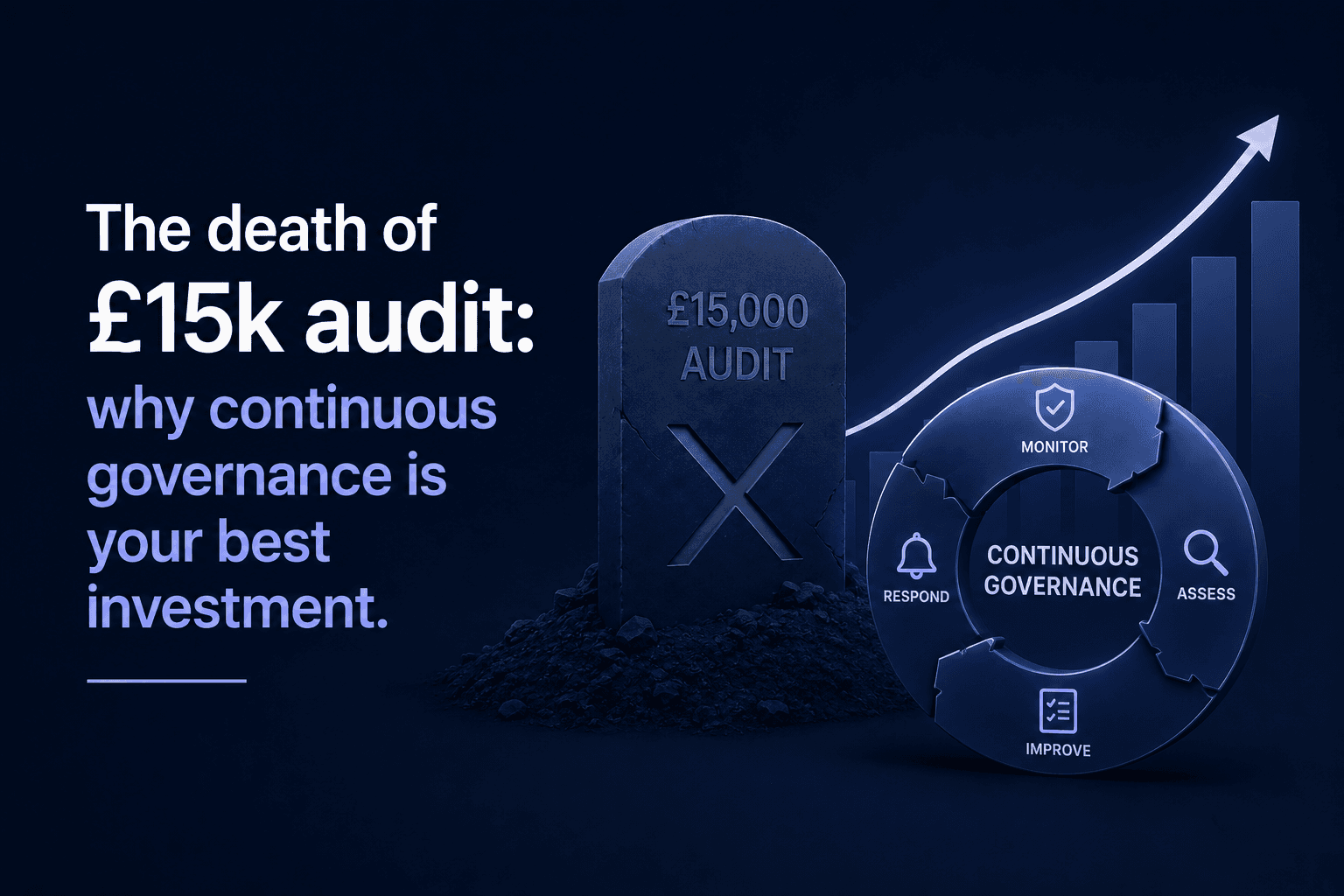
This is the genuine investment case for continuous governance. It is not that it makes the annual report cheaper. It is that it replaces a decaying asset, a snapshot that loses value from the day it's signed, with a living one that stays current, catches problems early, and is ready whenever it's needed.
Where Turma fits
This is precisely the distinction Turma is built around. Turma Assured is designed explicitly as a live governance system, not a static repository, and that phrase is doing real work.
In practice, that means a few things. The platform holds the company's AI policies, risk register, application audit, and supporting documentation as a live governance pack, with version control and an audit trail built in, rather than as files that age in a folder. Its Virtual AI Governance Officer (VAIGO) capability is designed to take in market and regulatory changes as they happen, assess which of them affect the business, and trigger the specific next steps , a policy review, an updated control, a management discussion, a fresh round of training, so the governance position tracks the moving environment rather than freezing at the point of the last review.
Evidence is captured continuously as actions are completed and acknowledged. Status is visible on a dashboard at any moment. And the exportable governance certification is drawn from current live data, so it reflects where the business actually stands today, ready for an insurer, a tender, or a partner's due diligence without a rebuild.
The contrast with the £15k report is the whole point. One is a photograph; the other is a live feed. One decays from the moment it's delivered; the other stays current by design. And because Turma owns and maintains the underlying policy templates, regulatory change is absorbed into the platform centrally rather than requiring the business to commission a fresh assessment every time the rules move.
A reasonable caveat: continuous governance does not abolish the role of professional advisors. There are moments, a complex legal question, a formal certification, a contested regulatory interpretation, where qualified human expertise is essential, and Turma is explicitly designed to support those moments rather than replace them. What it replaces is the wasteful pattern of paying repeatedly for a static snapshot that the world immediately overtakes.
A practical first step
If your AI governance currently lives in a consultant's report from some months ago, or in a spreadsheet someone updates when they remember, the most useful first step is an honest view of how current it actually is.
Turma's free Snapshot assessment is built for exactly this. It shows where your governance has already drifted out of date, where evidence is missing, and where the gap between your last assessment and today is creating exposure. It takes five to seven minutes.
The £15k audit isn't dying because audits don't matter. It's dying because a photograph of a moving target was never a sensible thing to keep buying. Continuous governance is the better investment for the simple reason that it stays true after you've paid for it.
Sources:
Trussed.ai, AI Governance Consulting: Costs, ROI & Selection Guide, April 2026 (on static assessments decaying in value and consultants returning to patch the same gaps)
Insightful AI, Cost of AI Consulting in the UK: What SMEs Actually Pay, 2025 (UK SMEs typically spend £15k, £50k on initial AI work; £15k feasibility/gap studies as a common entry point)
Helium42 / Nicola Lazzari / Bestech Sols, UK AI consultancy pricing guides, 2025,2026 (corroborating UK SME consulting cost ranges)
European Commission, AI Act implementation timeline and Digital Omnibus on AI simplification proposal (November 2025); Council of the EU and European Parliament provisional agreement, May 2026
CIO / K&L Gates / Baker McKenzie / Latham & Watkins, analyses of EU AI Act amendments and global AI regulatory developments, 2025,2026
UK Data (Use and Access) Act 2025 and ICO guidance on automated decision,making
Drata, Lemonade Case Study (200+ hours individual / 500,600 hours total audit prep before automation; "zero nonconformities" outcome)
Drata / Cycore, Calendly (90% reduction in audit preparation hours)
IDC study of Vanta customers (82% reduction in audit prep time; 526% ROI; three,month payback)
Secure.com, Thoropass, Konfirmity, AI Trust OS, LowerPlane , continuous compliance vs point,in,time audit analyses, 2025,2026 (control,failure detection in hours not months; ~$1.9m average breach saving via security automation; non,compliance costing materially more than compliance; audit prep reductions from 400+ hours to under 10)
This article is intended as general guidance for business leaders. The figures drawn from SOC 2 and security,compliance case studies are presented as evidence of the continuous,versus,point,in,time principle, not as AI,governance,specific results. Regulatory positions referenced are evolving and subject to commencement and further guidance. Specific compliance and contractual obligations should be confirmed with a qualified professional based on your own circumstances.