
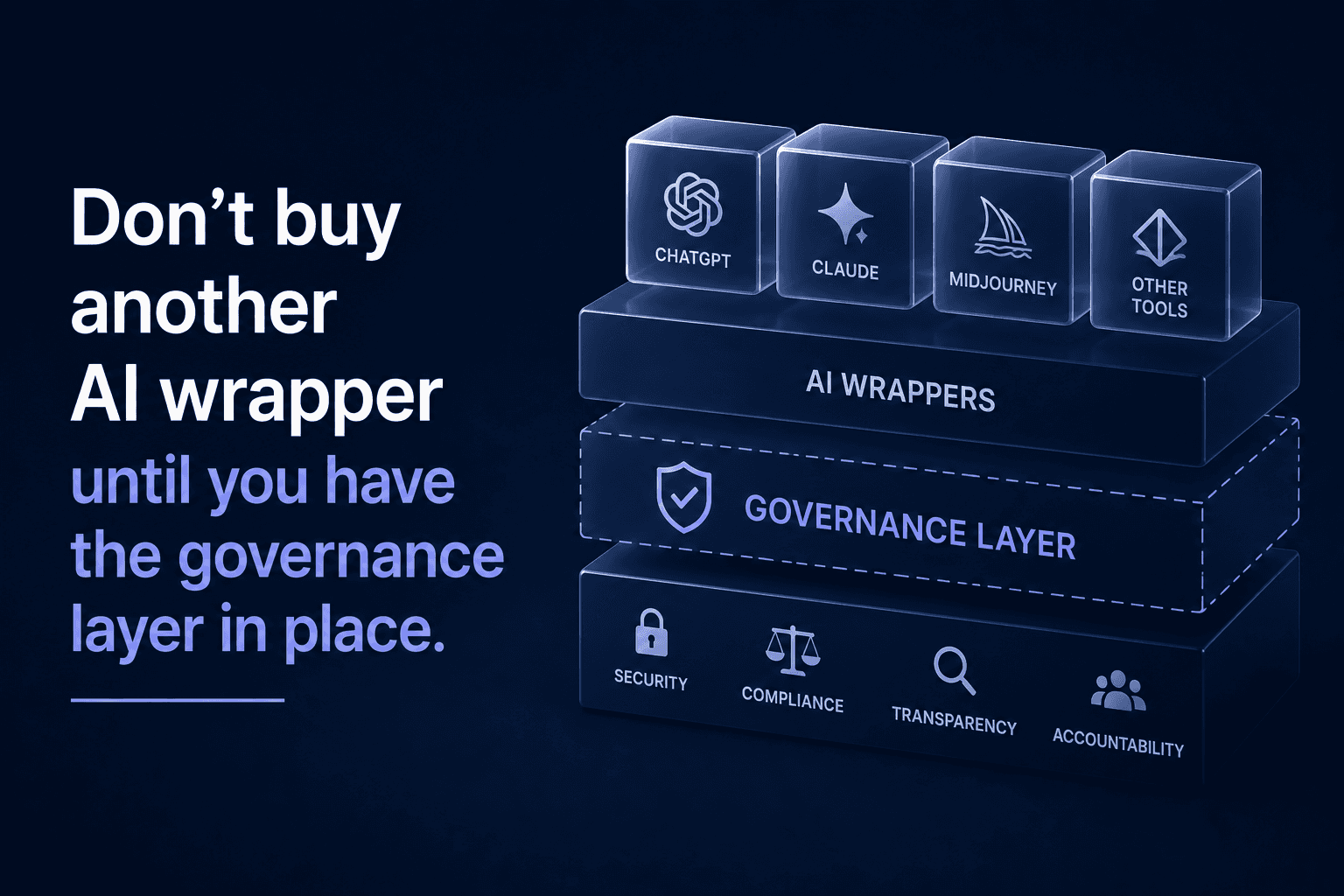
Don't buy another AI wrapper until you have the governance layer in place
Most enterprise AI software being sold today is built on the same handful of underlying models. The thing that determines whether your business gets value from it isn't the wrapper. It's the foundation you put underneath.
A familiar pattern, accelerating
Every fortnight a new AI tool lands in your inbox. Sales productivity AI. Legal-research AI. HR-screening AI. Meeting-summary AI. Each promises transformation. Each is, increasingly, a thin layer of interface and prompt design sitting on top of the same three or four foundation models.
The market term for these tools is "AI wrappers," and they aren't going away. Forrester's H2 2025 analysis of enterprise software earnings describes the current environment as "AI hype versus procurement power" a market where triple-digit growth is sometimes driven by clever bundling, and where lighthouse pilots dominate the landscape over genuine production capability. The CIOs reading those results are increasingly being asked the same question: which of these tools is actually going to deliver?
The honest answer is that the wrapper rarely decides the outcome. What decides the outcome is whether the business has built the foundations the wrapper sits on top of. The data on this is unambiguous, and uncomfortable.
What the transformation research actually shows
In April 2024, Bain & Company published findings from research into business transformation outcomes. The headline: 88% of business transformations fail to achieve their original ambitions. Only 12% deliver what they promised. Bain estimates that more than a third of large organisations are undergoing a transformation at any given time. The implication is that the majority of corporate change programmes — the ones consuming significant budget, leadership time, and organisational energy — quietly miss their mark.
The broader consultancy data tells the same story from different angles. Boston Consulting Group's 2020 analysis of digital transformations found that around 70% fail to meet their goals, a finding consistently echoed in McKinsey's work since. MIT's 2025 State of AI in Business study found that 95% of enterprise GenAI pilots fail to deliver measurable financial returns. BCG's 2025 Build for the Future study, surveying more than 1,250 firms worldwide, found that 60% of companies achieve no material value from their AI investments despite substantial spending.
These aren't five different problems. They are the same problem, told in five different ways. The technology works. The transformation around the technology does not.
Why foundations matter more than features
McKinsey's QuantumBlack team published a piece in April 2026 titled From AI Table Stakes to AI Advantage: Building Competitive Moats. The argument is simple and worth sitting with.
Apps and tools, McKinsey argues, can be copied. Any moat built on a particular AI feature, a particular vendor, or a particular product capability is temporary by design, because the same underlying models are available to every competitor, and the wrapper layer on top is increasingly trivial to replicate. The advantages that actually last are foundational: trust, data access, governance, organisational capability, change discipline.
The piece highlights specific examples. JPMorgan Chase, ranked first on the Evident AI Banking Index for four consecutive years, is one of the few banks publicly reporting realised AI returns, approaching $2 billion annually. The differentiation isn't a clever wrapper. It is the foundational trust, governance, and data infrastructure that allow the bank to deploy AI safely at scale and continue to be trusted by regulators and customers as it does so.
McKinsey's broader 2025 State of AI research reaches the same conclusion from the other direction. High performers, the small group capturing real EBIT impact from AI, are 3.6 times more likely than laggards to pursue transformational change, and 55% have fundamentally redesigned workflows when deploying AI compared to roughly 20% of others. The single strongest correlation McKinsey found with EBIT impact from AI is fundamental workflow redesign. Not model choice. Not vendor selection. Workflow and governance.
McKinsey's own 2026 AI Trust Maturity Survey, drawing on around 500 organisations, found that only about 30% of organisations reach a meaningful maturity level on strategy, governance, and agentic AI controls. The capability gap is not about who has bought which tool. It is about who has built the layer underneath.
What unmanaged AI procurement actually looks like
Picture a mid-sized professional services business twelve months after a serious AI push. The procurement record looks productive. There is a sales productivity tool. A document automation tool. A meeting-notes tool. Each was approved on its own merits. Each integration was sound. None of them did anything obviously wrong.
A year in, the leadership team can describe each tool, but cannot describe how they fit together, what data flows between them, who owns the governance, or what proportion of staff are using them well. When a senior client asks "What is your AI policy and how does it apply to my engagement?" the answer is a stitched-together response from three teams. When a tender pack asks for evidence of staff training on AI tools, the records exist in three different systems and don't reconcile. When the board asks where the ROI is, finance can show the cost. Nobody can show the return.
This is the cost of buying wrappers without the layer underneath. The tools are not the problem. The absence of a foundation makes the tools impossible to leverage, manage, defend, or improve.
The Informatica 2026 CDO Insights report, surveying 600 global data leaders across the US, UK, EU and APAC, describes exactly this pattern. 69% of companies have integrated GenAI into business practices, up from 48% the year before, but "this rapid integration is outpacing the essential foundational frameworks required for responsible and effective AI use." The phrase is precise. Integration without foundation.
The foundation that changes the equation
The governance layer is not, in this context, paperwork. It is the operating layer that determines whether any AI tool, current or future, can be deployed well.
A working foundation does five things at once:
Maps accountability. Someone is named, in writing, as responsible for AI oversight. Their authority is documented, their decisions are logged
Holds the live document library. Policies, registers, training records, application audit, GDPR and cyber documentation kept current as the market changes, not rebuilt each time something is asked for
Tracks the tools. A live inventory of every AI tool in use, who uses it, and on what data, including the ones procurement hasn't formally approved
Evidences the people. Staff training, attestation, completion records, and the behavioural signals that allow leadership to know AI is being used safely
Surfaces the change. When the market shifts, new regulation, new tool, new client requirement, the governance layer triggers the work to keep policy, training, and evidence aligned
A business with that layer in place can buy AI tools sensibly. The next wrapper sits on a foundation that can absorb it: policies extend to cover it, staff are trained on it, accountability is named, evidence is captured. The cost of adding new AI to the stack drops dramatically because the underlying infrastructure already exists.
A business without that layer, and this is the majority finds that each new AI tool creates its own mini-transformation. New policy. New training. New audit risk. New question from a procurement team. New conversation with the board. Each tool individually feels manageable. The cumulative weight of unmanaged tools is what causes the 88% to miss their ambitions.
The strategic leadership question
There is a quieter point in the McKinsey "table stakes to advantage" piece that is worth surfacing directly. Trust, governance, and the foundations they sit on are not just risk-management investments. They are strategic positioning.
In high-stakes domains: financial services, healthcare, legal, regulated technology, anything where a client's data is sensitive — buyers are increasingly screening suppliers on AI governance maturity. In B2B sales conversations, the supplier who can answer the AI question credibly progresses; the one who cannot does not. In tender processes, AI disclosure is now standard under UK Procurement Policy Note 017. In private sector procurement, AI vendor questionnaires are routine.
The same logic applies internally. Boards are starting to ask sharper questions about AI exposure. Insurers are pricing it. Regulators, the FCA in financial services, the ICO across data protection, are publishing increasingly specific expectations. A business that has built a governance foundation can answer all of these conversations from a position of confidence. A business that hasn't is improvising under pressure each time.
This is the strategic leadership case for foundations, and it isn't theoretical. It is the practical difference between businesses that compound advantage from each new AI tool they adopt, and businesses that quietly accumulate exposure with each one.
Where Turma fits
Turma is the governance layer. It is not another wrapper.
Turma Assured runs the live governance environment. It holds the company's AI policies, risk register, application audit, GDPR and cyber documentation in a single managed library, kept current as the market changes, with version control and audit trail built in. It maps accountability, tracks the tools, and surfaces what needs to happen by when. It produces the exportable certification that goes into tender responses, insurer requests, and partner due diligence, drawn from current live data, not reconstructed for each request.
Turma Passport runs the people layer, staff training, attestation, completion records, and behavioural evidence that turn policy into actual practice.
Together they form the foundation. Any AI tool a business buys, today's wrappers, tomorrow's agents, the productivity software it is currently evaluating, sits on top of a stack that makes that tool deployable, defensible, and measurable. That is what we mean by the foundational layer of your tech stack. Not another tool competing for attention. The layer that makes every other tool worth having.
The strategic leadership support is the same thing seen from the other end. Leaders making AI decisions need three things: a current view of where the business actually stands; a structured way to absorb the next change without rebuilding; and evidence to underwrite the conversations they are increasingly being asked to have. The platform is built to give them all three.
A practical first step
If you have bought AI tools in the last twelve months, or are about to, the most useful thing you can do before the next purchase is establish a structured view of where the foundations currently sit. Not an audit. A snapshot, quick enough to be useful this week, honest enough to inform the next investment.
Turma's free Snapshot assessment is built for exactly this. It identifies where governance is thin, where the tools currently in use are creating exposure, and where the foundations need to be built to make the next AI purchase actually pay off. It takes five to seven minutes.
The next AI wrapper will arrive. Probably this quarter. The question worth asking before it does is whether the layer underneath is ready to make it worth buying.
Sources
Bain & Company, 88% of Business Transformations Fail to Achieve Their Original Ambitions, press release and research findings, 15 April 2024
McKinsey & Company / QuantumBlack, From AI Table Stakes to AI Advantage: Building Competitive Moats, April 2026
McKinsey & Company / QuantumBlack, The State of AI in 2025: Agents, Innovation, and Transformation (n=1,993 respondents across ~105 countries)
McKinsey & Company, State of AI Trust in 2026: Shifting to the Agentic Era (n≈500 organisations)
McKinsey & Company / QuantumBlack, Reconfiguring Work: Change Management in the Age of Gen AI, August 2025
Boston Consulting Group, The Widening AI Value Gap / Build for the Future 2025 Global Study (n=1,250 firms across 68 countries), September 2025
MIT NANDA, The GenAI Divide: State of AI in Business 2025
Informatica from Salesforce, CDO Insights 2026: Data Governance and the Trust Paradox of Data and AI Literacy, January 2026 (n=600 global data leaders, US/UK/EU/APAC)
Evident AI Banking Index, 2025 edition, Evident Insights
Forrester, Enterprise Software Latest Earnings in H2 2025: The AI Hype Versus Procurement Power Battle, H2 2025
UK Cabinet Office, Procurement Policy Note 017, Improving Transparency of AI Use in Procurement
This article is intended as general guidance for business leaders. Specific transformation, procurement, and AI governance decisions should be reviewed with qualified professional advisors based on the facts of each business.